Lab News

11 June, 2017
New content - Several Apple-related product brochures:
- MacTCP
- A/UX 2.0
- X Windows for A/UX
- Macintosh II
- Macintosh IIx
- LaserWriter IInt
- Power Macintosh 8500/150 & 8500/180
- Franklin Ace 1000
R. Stricklin, curator
28 May, 2017
New content - A glossy TI Explorer brochure from September, 1984.
In other news, yes, I am still alive.
R. Stricklin, curator
10 June, 2014
New content - A glossy NeXT hardware brochure from 1990, corresponding to the release of the NeXTdimension and the first batch of 68040 machines.
By 1990, the Motorola 68000 family was beginning to look a bit feeble, judged by the standards of where the rest of the workstation market was already heading. In the graphics department, however, the performance of NeXTdimension told a very different story. Today we take full-color opaque window drags for granted. In 1990, this was bordering on witchcraft.
R. Stricklin, curator
27 October, 2013
New content - Data General Nova Logic Diagrams. These are tabloid-sized vellum ozalid process originals, with some hand annotations. They describe the original Nova machine, which predates the 800, 1200, and SuperNOVA. The print set may or may not be complete, but in its current state contains diagrams for the CPU, core memory, console, PSU, timing, and others. You can find it in the Retrotechnology Articles section of the site.
R. Stricklin, curator
2 June, 2013
New content - A couple of items from an April 1985 press kit from The Droid Works: glossy EditDroid and SoundDroid brochures, and an EditDroid FAQ.
The EditDroid was not a commercial success—Wikipedia claims only 24 were sold—but it sure is a nice piece of furniture.
R. Stricklin, curator
10 October, 2012
New content - SGI IRIS 3100 Series Workstations product guide, and Media Logic Artisan color paint application brochure. Shiny workstation cheesecake pinups! Whizzy screenshots! 3D! MEX! Geometry Engines!
R. Stricklin, curator
15 August, 2012
New content - SGI VMS XNS Series 2000/3000 Software Guide for Release N2.3. Hard to believe there was a time when an SGI needed to be fed data from a VAX. Or a time that includes ethernet... but not ubiquitous TCP/IP.
R. Stricklin, curator
13 August, 2012
New content - Apollo Computer Inc. Second Quarter Report 1985. Apollo were still a year away from introducing their most successful series of machines with the DN3000, and somehow amongst all the congratulatory language and hedged bets, I get the sense that Apollo were finding business more difficult than they had imagined.
R. Stricklin, curator
24 April, 2012
New content - IBM 5250 Information Display System Introduction. This is the father of all of IBM's twinaxial terminals, introduced with the System/34, and still in use today with iSeries.
R. Stricklin, curator
22 April, 2012
New content - IBM System/36 Facts Folder. Have an inexplicable itch to review the features and characteristics of the System/36 platform? Don't ignore it; satisfy it.
R. Stricklin, curator
21 April, 2012
New content - the remaining three System/36 brochures to match the Business Graphics one I published in February. These three are generally less gratuitously silly: Flexible Communications, Integrated Office Applications, and a fold-out poster with pictures and feature summaries of the assorted hardware in the System/36 ecosystem. Viva la '80s!
R. Stricklin, curator
12 February, 2012
New content - IBM System/36 Business Graphics fact folder in the Articles section. They seem proud, but all I can see are the limitations: graph up to 8 lines, plotting up to 24 values each! The artifice by which they bulked this up to an entire eight page glossy is pretty hilarious.
R. Stricklin, curator
1 January, 2012
New content - SGI Indigo2 Product Guide in the Articles section. A flashy brochure for a flashy machine.
Happy new year, everyone.
R. Stricklin, curator
29 December, 2011
New content - IBM PC AT/370 Facts Folder in the Articles section. It's nice to finally have some solid information about this obscure system. It's a marketing glossy, but still better than apocryphal ramblings!
Other sections of the site—such as the media vault, project notes, and hardware and software inventories—are filling out slowly, without much fanfare. But they are nonetheless being continually updated.
R. Stricklin, curator
25 May, 2011
CSS updates - primarily dealing with formatting of console output, and dealing with tables in a slightly more sophisticated way. Fun stuff. Check it out!
R. Stricklin, curator
30 June, 2010
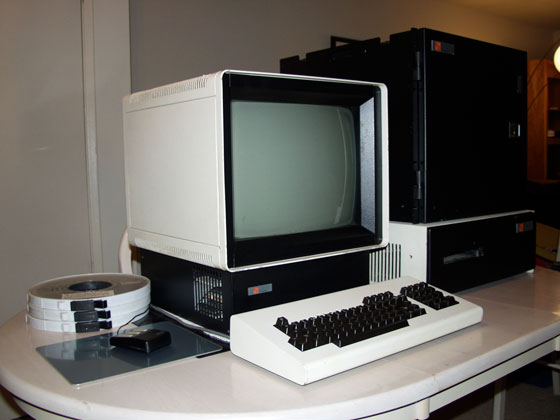
I've been waiting for this day for a very long time.
R. Stricklin, curator
28 April, 2010
Redid the Retrotechnology Articles section, again; still trying to work out how best to solve the latent organizational issues. In retrospect, adding intermediate "card catalog" pages between the index and the actual PDFs was probably not a great help. Getting rid of them, and expanding some of that data into the index itself, feels like a reasonable compromise; I'm satisfied for now. Feedback is, as always, welcome.
Perhaps the thumbnails can be improved slightly, later.
New content - at long last, there is content in the Restoration Projects section. I have converted some of the problem logs I maintain for each system to HTML and made them available here. There are setup and installation notes in addition to the normal problem-solving breadcrumb trails. It's possible I'm not the only person who will ever run into these problems; with luck an item or two might be just the thing that's needed to save somebody else from tearing their hair out as I did mine.
R. Stricklin, curator
25 April, 2010
New content - Convergent Technologies release notice for 3.1 Video Access Method (SAA-3401). Includes a brief overview of the various display options for CTOS systems ca. 1989.
R. Stricklin, curator
28 February, 2010
So, I failed to spend time working on other projects.
New content - Convergent's 8086 CTOS Assembly Language Manual. With a copyright date of 1980, I suspect this is probably from the very first generation of CTOS (perhaps even slightly before), which I suppose makes it at least slightly remarkable. Probably nobody's writing new assembler programs on CTOS these days, but hey---maybe somebody will start.
R. Stricklin, curator
26 February, 2010
New content - Convergent's CTOS Debugger Manual. Got bugs?
I should probably spend some time now working on other projects for a while.
R. Stricklin, curator
25 February, 2010
New content - SR9.2 Getting Started With Your DOMAIN/IX System. If you've never tried to use an Apollo DOMAIN workstation before, you could probably be forgiven for assuming that because it has UNIX and a GUI that it should be relatively simple to log in and find yourself immediately comfortable enough to do some work. Perhaps you are expecting a brief skirmish with the dustier corners of the UI before that happens. You could easily be forgiven for this.
...but you would be wrong. Go to the Articles section and read this book first; you can thank me later.
R. Stricklin, curator
24 February, 2010
New content - The 1.1d6 release of the BeBook. This API reference represents the state of progress in the BeOS at the time the very first public (non-Be) developers were seeded, in the last days of 1995.
Even in its final R5 form, the BeOS always felt hopelessly incomplete to me. There's even less to be found in 1.1d6. The "hardware kit" sports a single API, for addressing serial ports. The "network kit" is a single page, darkly hinting that there might (or might not) be something vaguely resembling a Berkeley sockets API. There is no way to access the secondary MIDI ports, and the window system is incapable of running in resolutions other than 640x480 or 800x600.
If nothing else it serves as an object lesson in just how much work there is to be done in developing a fully modern OS from scratch. To have undertaken it simultaneously with an effort to develop a fully modern hardware platform from scratch was a simply Augean task. Don't get me wrong, they had realized a lot by 1995; even still it's a long, long way off from a completed system. Frankly it's a miracle they accomplished as much as they did.
R. Stricklin, curator
12 February, 2010
New content - SR9.0 DOMAIN/IX User's Guide. This document gives you a sense of how Apollo approached reconciling UNIX with AEGIS and the almost immediate feeling of how badly schizophrenic the resulting system was, in many ways. It was a heroic, but ultimately doomed effort. Contrasting it with Apple's experiences (IMO successfully) reconciling UNIX with Classic MacOS in OS X is especially revealing.
At the very least it's worth looking at the appendices, which reprint a good many classic UNIX research papers from the heyday of the Berkeley CSRG.
R. Stricklin, curator
2 November, 2009
I finally figured out how to make InDesign set inline text with a box around it. The SGI IRIS documents make frequent use of this convention, to indicate keystrokes and back-panel connections. I have corrected the affected PDFs in the Articles section.
New content - Convergent Technologies release notices for 12.2 DV Build Tools (SAA-1300), 11.4 Linker (SAA-3101), and 11.3 Math Server (SAA-3100).
R. Stricklin, curator
23 August, 2009
Redid the Media Vault section with thumbnails and improved CSS. Added a couple of new screen captures while I was at it.
R. Stricklin, curator
4 January, 2009
New content - Convergent Technologies release notices for 11.3 / 11.4 Standard Software (SAA-3100), and 11.5 Standard Software Update (SAA-3101). If you are working on restoring an NGEN CTOS or BTOS system, these release notices have good information on required versions, performing the install, and how the distribution media is laid out.
R. Stricklin, curator
30 December, 2008
New content - I have just uploaded the first PDF from my library of Convergent Technologies NGEN system documentation: the CTOS/VM Concepts manual. It describes all the system services present in CTOS, from a programmer's perspective, and is fairly comprehensive.
I hadn't realized how advanced CTOS was by 1987. There are a lot of features in it which, at the time, were primarily only present in midrange or mainframe systems. In terms of sophistication, I think it was well advanced compared to contemporary UNIX releases, though perhaps somewhat less flexible. As an operating system for a series of machines built around the intel x86 processor, it really demonstrates just how abysmally pathetic MS-DOS was. OS/2 1.0 hadn't been released yet, but would represent only the tiniest of baby steps toward what was already in CTOS/VM.
R. Stricklin, curator
5 June, 2008
New content - Three new SGI publications are available in the Retrotechnology Articles section of the site: Using the Light Pen, Using the Laser Printer, and Using the Color Printer. These documents are contemporary with the IRIS 2000 and IRIS 3000 series machines.
R. Stricklin, curator
31 May, 2008
Cleaned up the typesetting in the SGI PDF collection quite a lot. This should facilitate more accurate text indexing for Google, et al. The documents have been re-edited to clean up some mistakes, and the fonts now much more closely match those in the originals.
New content - SGI IRIS Series 3000 Owner's Guide, Version 2.0. This complements the Version 1.1 document already published here. It adds information on the IRIS Series 3100 systems, GL2-W3.5, and has an intact Chapter 7 (Optional Peripherals) which is missing from my copy of Version 1.1. Two early editions of Silicon Graphics Pipeline---Fall 1985 and Spring 1986---have been added to the site, as well.
CSS update - When I coded the CSS for this site, no currently available browsers supported the nth-child rules. Safari 3.1.1 finally adds support for them; therefore, tables on the site now render as intended. It's possible that other browsers also have recently added, or may soon add support. I may be inspired to tweak the CSS a bit.
R. Stricklin, curator
28 July, 2007
New content - Compaq Deskpro 386 Personal Computer Maintenance and Service Guide. You know where to find it.
Enjoy.
R. Stricklin, curator
28 March, 2007
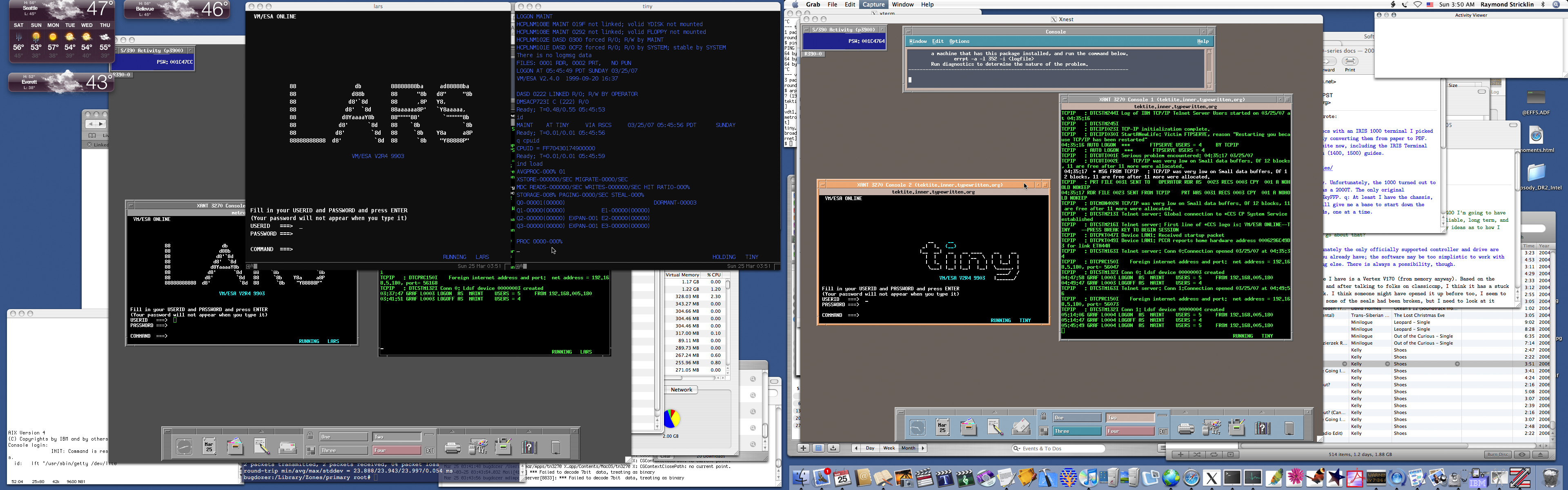
I'm coming up for air after having been working on the restoration of a couple of IBM R/390 systems. I had an existential moment during the process and did a quick screen grab representing a single instant in a week-long, heads-down, hardcore hack session. I can't say it's exactly an everyhacker sort of artifact as there aren't many folks who look at 3270 sessions on a regular basis anymore, but it's still somehow connected on a fundamental level to a sort of hacker's collective subconscious (if such a thing could be said to exist).
Also, I get asked a lot by friends and family, "so what is it you do at work?"
Well, this is it.
R. Stricklin, curator
10 March, 2007
The Retrotechnology Articles section is getting big enough that it's starting to face some organizational shortcomings which will only get worse as things grow. I'm starting to distill some ideas on how to tackle the problem; as a first step I've started reorganizing the documents into a card-catalog type structure, where the links in the index lead to an intermediate page with document metadata and a link to download the PDF. Hopefully this will assist people browsing the listings casually. It's clear more work needs to be done on this subject before much longer, but it's not yet immediately apparent what form the necessary work will ultimately take on.
New content - Servicing the HP Apollo 9000 Series 400 Workstations is now available in the Retrotechnology Articles section of the site. It is packed with great information on troubleshooting and repairing a Series 400 workstation, whether it is running DOMAIN/OS or HP-UX. It includes block diagrams, illustrated parts breakdowns, disassembly instructions, diagnostics procedures, LED error codes, FRU part numbers, and much, much more. If you have a broken S400 workstation, you need this.
Acknowledgements - The paper copy of this manual was donated to the museum by Michael Wolfson.
R. Stricklin, curator
14 January, 2007
New content - The HP HP-UX Installing Peripherals guide for HP 9000 Series 300 workstations is now available in the Retrotechnology Articles section of the site. This manual has it all: DIO-I and DIO-II cards, memory cards, HP-IB peripherals, disk drives, tape drives, printers, plotters, graphics processors, terminals, HP-HIL options, switch settings, select codes, device major and minor numbers, everything. If you are restoring a S300 workstation, you need this.
Acknowledgements - The paper copy of this manual was donated to the museum by Michael Wolfson.
R. Stricklin, curator
29 August, 2006
New content - The IBM RT PC Options Installation guide is now available in the Retrotechnology Articles section of the site. If you are trying to restore one of these machines, or even just identify some unknown RT board, this document has what you want. The only thing it doesn't really cover is the various RT processor options, though FPA and PC Coprocessor options are included.
In case anybody was wondering, the careless safety notice translations are exactly as originally published by IBM. Shocking, I know.
R. Stricklin, curator
31 July, 2006
New content - The IBM RT PC Virtual Resource Manager Programming Reference is now available in the Retrotechnology Articles section of the site. There is a lot of good information in there about how the VRM works, including the VRM debugger and some information on the floating-point emulation layer. The latter also discusses in some depth the salient characteristics of the various floating point options available on the RT PC.
It's pretty interesting stuff. I hadn't realized how much like CP (VM/370) the VRM is, conceptually.
R. Stricklin, curator
19 May, 2006
New content - The HP Apollo 9000 Series 400 HP-UX Owner's Guide is now available in the Retrotechnology Articles section of the site. I'm shocked at what a lousy manual this is. It is easily the most useless manual I've published here. It's inappropriately conversational, unnecessarily vague, stultifyingly repetitious, and overloaded with unhelpful pictures.
But it's available for your reference. Enjoy.
R. Stricklin, curator
8 April, 2006
Two things:
New content - found a reduced, badly xeroxed copy of the SGI GL2-W3.5 Workstation Release Notes that I was able to massage into a workable PDF. It is uploaded and available in the Retrotechnology Articles section of the site.
CSS update - changed text-size: small; for font-size: 0.75em; which seems to give me the desired results in more browsers. Also removed the more baroque formatting rules for the large tables in favor of the much cleaner and completely unsupported in any browser nth-child rules. It's definitely the right thing; maybe eventually the browsers will catch up.
I really should be spending my time working on other projects right now. My avoidant personality is your gain.
R. Stricklin, curator
30 December, 2005
This is the last update before the new year.
I've been using my Christmas vacation to convert the site to CSS. The HTML is essentially completely converted; I just have some fine-tuning left to do on the style sheet itself. In a nutshell, there is one tough problem involving the visual presentation of the fhlushstones benchmark results table, as well as a small handful of minor outstanding visual issues relating to over-width content and some rendering peculiarities in IE which I may never solve satisfactorily. The CSS renders 100% correctly in both OmniWeb and Safari; Firefox gets everything right except (inexplicably) text-size: small;, and IE blows cold spew into dixie cups.
But you knew that already.
Also, there are five new Apollo software release documents contemporary with DOMAIN/IX SR9.5 (ca. 1987) published now in the Retrotechnology Articles section of the site.
R. Stricklin, curator
13 December, 2005
I decided to take a break from tradition and prepare the first non-SGI content to the PDF collection: the Apollo DOMAIN System User's Guide.
It was shocking how lousy the typesetting was, especially in comparison to what SGI, which was a brand new company at the time some of these docs were originally published, managed to produce. Apollo had been around for several more years, and despite having produced the documentation with Interleaf, there were a horrifying number of spelling errors, generally sloppy typesetting: inconsistent typefaces, margins both generous and stingy by turns, and so forth.
After some vigorous internal debate, I made a point to correct the obvious mistakes---especially where it confounded meaning---but some of the random typesetting is still present. I strive for historical accuracy, but I have no doubt had I not corrected the blatant errors, I'd be receiving an endless stream of corrections submitted by email...
Anyway, it's available for download now. Google will index it in the next couple days, if past results are any indication of future returns. I'm up way too late. Merry Christmas; this is probably the last update before the New Year.
R. Stricklin, Curator
3 December, 2005
SGI's GL2-W3.6 Workstation Release Notes are now available in the Retrotechnology Articles section of the site.
R. Stricklin, curator
21 November, 2005
SGI's GL2-W2.4 Workstation Release Notes are now available in the Retrotechnology Articles section of the site.
R. Stricklin, curator
20 November, 2005
Uploaded the PDF of the SGI GL2-W3.4 Workstation Release Notes. Take a look in the Retrotechnology Articles section of the site.
There are a handful of screen captures up in the Media Vault section, now. There didn't used to be anything there at all.
R. Stricklin, curator
16 November, 2005
Finished converting the SGI IRIS 3000 Series Owner's Guide to PDF. It's uploaded and available in the Retrotechnology Articles section of the site. As always, drop me a line if you find it useful, or discover any errors.
R. Stricklin, curator
11 January, 2005
Has it really been a year already?
I've just uploaded the first of a few PDFs of old SGI manuals relating to the IRIS 1000, 2000, and 3000-series machines. The OCR software did not produce satisfactory output, so I redid all the layouts and typesetting manually. The process is tedious, but the results are superior. Enjoy, and let me know if you find any errors.
R. Stricklin, curator
4 January, 2004
I've just been motivated to upload an (embarrassingly small) content refresh. At this rate, this site is shaping up to be more of a retirement project than anything else. We'll have to see what we can do about that, this year.
During the Summer of 2003, I did finally fit the last puzzle pieces into the AViiON NVRAM disassembly---at least enough to finish resurrecting my AV310CD---thanks to several good sports reading this site.
- Dan Veeneman
- Lubomir Sedlacik
- Steven M. Jones
- Tom Ponsford
Special thanks to Tom Ponsford, who shrewdly managed to dig up what is probably the only AV300CD in existence with a still-functioning NVRAM. I'll be putting together some documentation on this topic and posting it soon.
R. Stricklin, curator
12 November, 2002
I've been going over the HTTP referrer logs, and I noticed a number of hits to the site have been from folks doing fairly broad searches. That's pretty flattering. At the same time, it makes it hard to evaluate just what information folks are after, and whether or not they left the site with that information. It doesn't make it easier that there's still a whole pile of content I'm planning to put up eventually, but which is not actually present on the site, yet.
In the meanwhile, I'd like to solicit the input of those of you who are ending up on this site as the result of a web search.
Consider taking the time to drop me a line to let me know what you were after, and whether you found it or not. That goes double for those of you using any of these or similarly broad search phrases:
- Deskpro 590 XL
- SPARCstation 20
- Sun 411
- STP3010PGX
Your input will help me prioritize content development on this site.
R. Stricklin, curator
11 November, 2002
Since we seem to be getting hits from people actually looking for information, I've been inspired to do a bit of a facelift on the site. Enjoy.
R. Stricklin, curator